
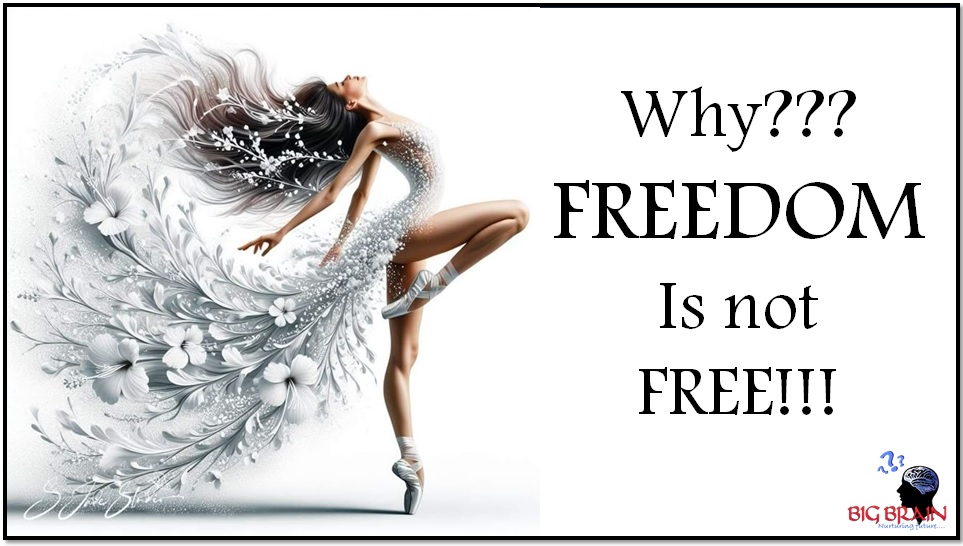
The Enduring Price of Liberty: Why Freedom Demands Constant Payment
The declaration that “freedom is not free” echoes through history not as a simple proverb but as a profound and unsettling truth. It is a compact phrase that belies an immense, complex, and ongoing transaction between the individual and the collective, the present and the future, desire and duty. To understand this is to move beyond cliché and confront the sobering reality that liberty is not a static state of being but a dynamic, costly achievement—purchased in blood, maintained through vigilance, balanced by restraint, and secured only through the perpetual willingness to pay its price across generations.
The Initial Cost: Blood and Sacrifice
The most visceral and unambiguous price of freedom is measured in lives. This is the founding cost, the steep down payment for liberation from oppression. It is the soldier on a distant battlefield, the revolutionary in the town square, and the dissident in a prison cell. Their sacrifice is the ultimate currency in the economy of liberty. Historical memory is built upon these sacrifices, from the battlefields that birthed nations to the silent courage of those who stood against tyranny in peaceful protest. This cost is non-negotiable and absolute; it represents the point where abstract ideals of freedom collide with the brutal mechanics of power, requiring the ultimate forfeit to alter the course of history. It is a debt owed by the living to the dead, a debt that can only be repaid through remembrance and the responsible stewardship of the liberty they secured.
The Civic Price: The Daily Labour of Liberty
If the sacrifice of life is the dramatic capital expenditure, the civic price is the demanding, often mundane, monthly mortgage. This is the cost borne not in a single, heroic moment, but in the accumulated actions of daily life within a free society. It is the hard work of informed citizenship: the time spent discerning truth from falsehood, the effort of engaging in thoughtful discourse, the act of voting with conscience rather than convenience, and the willingness to serve on a jury. It is the energy required to hold institutions accountable and to defend the rights of others, even when their views are disagreeable.
The philosopher John Stuart Mill warned of the “tyranny of the prevailing opinion,” a subtle force that can erode freedom as effectively as any dictator. Combating this requires the constant, active participation of the citizenry. When this civic vigilance wanes—when apathy replaces engagement, when convenience triumphs over principle, when tribal loyalty overrides reasoned debate—the foundations of freedom begin to crack. The maintenance of a free society is therefore an endless project of repair and renewal, demanding not just passion but patience, not just rights but responsibilities.
The Paradoxical Price: Restraint as the Engine of Freedom
Perhaps the most intellectually demanding cost of freedom is the paradoxical necessity of self-limitation. Absolute, unbounded individual freedom is a logical and practical impossibility in a social context; one person’s absolute freedom inevitably becomes another’s subjugation. Therefore, the freedom of a society is not the sum of its individuals’ unrestrained wills, but the product of a shared agreement to live under a common set of rules.
This is the profound insight of the social contract, articulated by thinkers like John Locke and Jean-Jacques Rousseau. We willingly consent to limits on our own conduct—to obey traffic laws, respect property rights, and forego violence—not to diminish our liberty, but to create the conditions under which a stable and broad liberty for all can flourish. The rule of law, therefore, is not the enemy of freedom but its essential architect. It transforms the chaotic potential for conflict into a predictable framework for coexistence. In this light, every law, every social norm, and every act of personal restraint is a payment toward the collective account of communal freedom, a recognition that my liberty finds its boundary at the tip of your nose.
The Economic and Social Investment
Freedom also carries a substantial material and social price tag. Economically, free societies invest enormous resources in the architecture of liberty: an independent judiciary, a professional military under civilian control, public education to foster informed citizens, and systems to ensure transparent governance. These are not spontaneously generated; they are built and sustained by public treasury—by taxes—which represent a collective investment in the infrastructure of freedom.
Furthermore, the economic freedom to innovate and compete is inseparable from a framework of political liberty that protects property rights and enforces contracts. Studies consistently show that nations with greater political and economic freedoms achieve higher long-term prosperity. However, this prosperity is not automatic; it requires continual investment and a willingness to tolerate the creative destruction and inequality that free markets can generate, while using the tools of that free society to mitigate their excesses. The price here is both financial and social, requiring a balance between unleashed opportunity and compassionate community.
The Intergenerational Debt
Crucially, freedom is not a one-time purchase with a lifetime guarantee. It is an intergenerational trust, a legacy passed down that each new cohort must earn anew. The “debt” to past generations is not discharged by passive inheritance; it is honored only through active preservation and adaptation. Each era faces unique threats to its liberty—whether from technological surveillance, ideological polarization, environmental collapse, or resurgent authoritarianism. The specific defences required will change, but the requirement for vigilance does not.
This means that the price of freedom is perpetually being renegotiated. The battles of the 18th century for representative government differ from the battles of the 20th century against totalitarianism, which in turn differ from the 21st-century struggles to protect digital privacy and epistemological truth. The currency may change—from muskets to lawsuits, from pamphlets to encryption—but the fundamental transaction remains: liberty must be understood, valued, and defended, or it will be lost.
Conclusion: A Perpetual Obligation
In the final analysis, “freedom is not free” because it is not a noun describing a possession, but a verb describing a condition that must be continually enacted. Its price is paid in the currency of sacrifice, the labour of participation, the discipline of self-restraint, the investment of resources, and the acceptance of an unending obligation to the future. It is the most expensive thing a society can possess, precisely because its cost is never fully paid. To take it for granted, to assume it is a default setting rather than a hard-won achievement, is to begin defaulting on the installments. And history shows with brutal clarity that when the payments stop, the repossession of liberty is swift and merciless. True freedom, therefore, resides in the conscious, daily acceptance of its weight, ensuring that its light, paid for by so many, is never extinguished.