
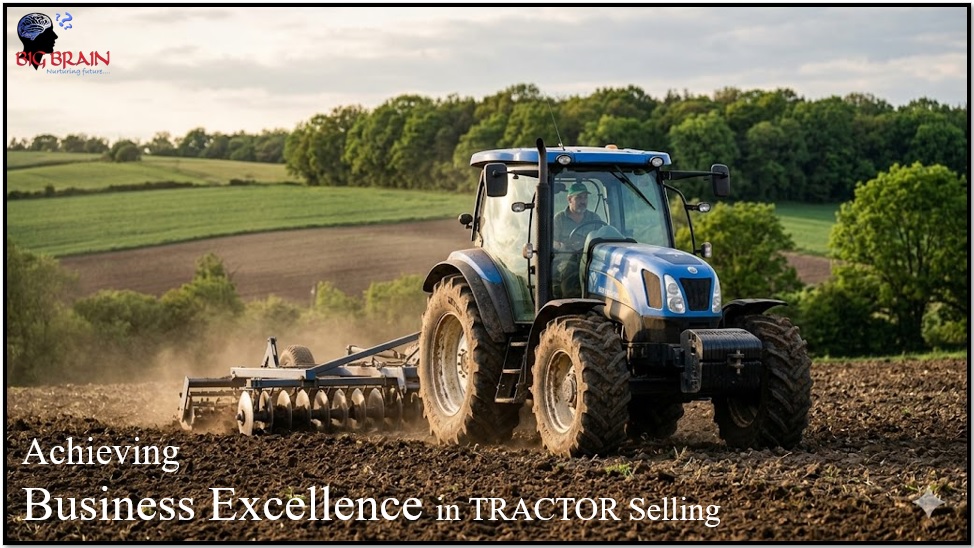
Achieving business excellence in tractor sales requires transitioning from a product vendor to a strategic partner in agricultural productivity. Success is driven by the KSA framework, where deep technical knowledge of torque and fuel efficiency meets an attitude of ownership toward the farmer’s harvest. Excellence means prioritizing total cost of ownership over initial price, demonstrating how genuine parts and proactive maintenance prevent costly downtime during peak seasons. By leveraging consultative storytelling and predictive support, you build a brand rooted in reliability and integrity. Ultimately, your goal is ensuring operational continuity, transforming every sale into a long-term commitment to the client’s success.
1. The Paradigm Shift: From Tractor Sellers to Agricultural Partners
In the tractor business, we do not simply sell machines; we sell productivity, self-sufficiency, and generational prosperity. To achieve business excellence, we must shift our mindset from being transactional “tractor movers” to trusted agricultural business consultants.
The landscape has evolved dramatically. Today’s farmer is not merely a tiller of soil; they are an agri-entrepreneur managing a complex enterprise with variables ranging from weather patterns and commodity prices to labor availability and government policies. Our clients are looking for more than horsepower and hydraulic lift capacity—they seek operational efficiency, financing solutions, reliability during critical seasons, and long-term partnership.
Business excellence in tractor selling is defined by four pillars: Deep Agricultural Understanding, Consultative Selling, After-Sales Dependability, and Community Trust. If we fail in any of these, we become just another steel box on a dealer lot—interchangeable and forgettable.
2. Know the Land, Know the Farmer, Know the Application
The worst mistake a tractor sales professional can make is treating every customer the same. A 50HP tractor used for 500 acres of row crop farming is a vastly different proposition than a 50HP tractor used for a 50-acre orchard or a 20-acre vineyard. Excellence demands that we understand the application—not just the specifications.
-
Understand the Agriculture: You must know the agricultural calendar of your territory. What are the planting windows? When is harvest? What are the specific soil conditions? A farmer facing a narrow harvest window does not need a feature-rich tractor that takes three days to understand; they need a reliable workhorse that starts on the first turn of the key at 4:00 AM.
-
Ask the Right Questions: Move beyond “How many acres do you farm?” Dig deeper:
-
What crops do you grow, and what is your rotation cycle?
-
What implements do you currently own or plan to purchase?
-
Who will be operating the tractor—the owner, a hired hand, or a family member?
-
What is your existing fleet? Are you replacing a machine or adding capacity?
-
What are your biggest operational frustrations with your current equipment?
-
-
Match the Machine to the Task: A tractor that is undersized will be overworked, leading to premature failure and fuel inefficiency. A tractor that is oversized will carry unnecessary capital cost and fuel consumption. Our job is to calculate the optimal fit—the Goldilocks machine that provides sufficient power for the heaviest implement while remaining economical for daily tasks.
3. Consultative Selling: The Total Cost of Ownership Conversation
In tractor selling, price is a headline, but value is the story. The cheapest tractor on the lot often becomes the most expensive tractor the farmer ever bought—through downtime during harvest, poor resale value, and inadequate dealer support when it matters most.
We must master the art of selling Total Cost of Ownership (TCO) rather than initial purchase price.
The Value Conversation:
“Mr. Patel, I understand there are tractors available with a lower sticker price. But let’s look at what that price actually buys you. When your crop is ready and the weather window is three days, will that tractor start every single time? When a component fails during the season, will that dealer have the part in stock and a technician available to get you back in the field within hours—or will you wait weeks? And when you decide to upgrade in five years, will that tractor still hold 70% of its value, or will you struggle to find a buyer? Our tractor may cost more today, but over five years of ownership, it will cost you less. Let me show you the numbers.”
Key TCO Components to Articulate:
-
Fuel Efficiency: A more efficient engine saves thousands over the life of the tractor.
-
Reliability/Uptime: Calculate the cost of a breakdown during peak season. A single day of lost planting or harvest can wipe out the price difference between tractors.
-
Resale Value: Premium brands maintain higher residual values. This is not a cost; it is an asset that returns capital at trade-in time.
-
Warranty Coverage: Longer, more comprehensive warranty translates to predictable ownership costs.
-
Parts Availability: A dealer network with high fill rates means minimal downtime.
4. Financing and Business Case: Enabling the Purchase
For most farmers, a tractor is not a discretionary purchase—it is a capital investment that must generate returns. If we cannot help the customer build a compelling business case, we will lose the sale regardless of how good the machine is.
-
Understand the Customer’s Financial Cycle: Farmers have cash flow cycles tied to harvest and commodity sales. A proposal that requires a large down payment during the lean season is a non-starter. We must align payment structures with their cash flow reality.
-
Master the Financing Tools: Excellence requires fluency in:
-
Seasonal payment plans (payments aligned with harvest receipts)
-
Skip payment programs
-
Lease options vs. purchase
-
Trade-in valuation and structuring
-
-
Build the Business Case: Help the customer quantify the return. “This tractor will allow you to complete your planting in 5 days instead of 8. Those 3 days saved allow you to optimize your planting window, which historically adds 8% to your yield. Based on your acreage, that translates to an additional ₹X this season alone. The tractor effectively pays for itself within two seasons.”
5. The Power of the Demonstration: Let the Machine Speak
A brochure can list specifications, but only a demonstration can create conviction. The demo is where we transition from talk to proof.
Principles of an Effective Demo:
-
Go to Their Land: Wherever possible, conduct the demo on the customer’s own farm, with their own implements. This eliminates doubt and builds immediate relevance.
-
Let Them Drive: Do not just show; let them operate. Let them feel the steering response, the clutch engagement, the visibility from the seat. Ownership begins the moment they sit in the operator’s station.
-
Highlight Pain Point Solutions: If the customer complained about difficult implement attachment, demonstrate the ease of the quick-attach system. If they worried about operator fatigue, demonstrate the suspension seat and ergonomic controls. Show them how you solve their specific frustrations.
-
Involve the Operator: If the tractor will be operated by a hired driver or a family member, ensure they are part of the demo. Their acceptance is critical—a driver who dislikes the machine will find reasons to complain about it.
6. After-Sales Excellence: Where Loyalty Is Built or Broken
In tractor selling, the sale is not the finish line; it is the starting line. The relationship after the sale determines whether we earn a repeat customer, referrals, or a detractor who warns others away.
The Non-Negotiables of After-Sales Service:
-
Parts Availability: During critical seasons, a missing filter or belt can mean days of lost productivity. We must maintain deep inventory of high-wear items and critical components. When a farmer needs a part during harvest, “we can order it” is an unacceptable answer. “We have it in stock, and our service van is on the way” is the only acceptable response.
-
Service Responsiveness: A breakdown during planting or harvest is an emergency. Our service department must operate with the urgency of an emergency room. Same-day response, mobile service units, and loaner equipment arrangements during extended repairs are not perks—they are expectations.
-
Proactive Outreach: Do not wait for the customer to call with a problem. Reach out before the season begins: “Mr. Patel, planting season starts in three weeks. We’d like to bring your tractor in for a pre-season inspection to ensure everything is in perfect condition. No charge.” This simple gesture prevents downtime and demonstrates genuine care.
-
Warranty Advocacy: When warranty issues arise, we must be the customer’s advocate with the manufacturer. A customer who feels we fought for them will remain loyal for life.
7. Know the Ecosystem: Implements, Technology, and Allied Products
A tractor is rarely a standalone purchase. It is the heart of an ecosystem that includes implements, precision agriculture technology, and allied products.
Expanding Share of Wallet:
-
Implements: The sale of a tractor should trigger a conversation about implements. Does the customer have the right tillage equipment? Are their implements matched to the new tractor’s capabilities? A mismatch leads to poor performance and customer dissatisfaction.
-
Precision Agriculture: GPS guidance, auto-steer, yield monitoring, and variable rate technology are no longer optional for progressive farmers. We must be conversant in these technologies and how they drive efficiency—reducing input costs (seed, fertilizer, fuel) while increasing yields.
-
Ancillary Products: Front-end loaders, canopy/cabs, rear remote kits, and ballasting solutions should be discussed as part of the initial purchase, not as afterthoughts. Bundling these into the financing package simplifies the customer’s decision.
8. Building Community Trust: The Ultimate Competitive Advantage
In rural markets, reputation travels faster than any marketing campaign. A satisfied farmer tells three people; a dissatisfied farmer tells the entire village cooperative. Trust is built through consistency over time.
How We Build Trust:
-
Be Present: Attend local agricultural fairs, farmer meetings, and cooperative gatherings. Do not just show up with brochures—show up to listen and learn. Be visible in the community.
-
Support Local Agriculture: Sponsor local farming events, support youth agricultural programs (like 4-H or FFA equivalents), and demonstrate genuine investment in the community’s agricultural future.
-
Honor Commitments: If you promise a delivery date, deliver on that date—or communicate transparently before the deadline if there is a delay. If you promise a service call time, be there. Consistency builds reliability; reliability builds trust.
-
Stand Behind Your Product: When a customer has a legitimate issue, do not hide behind warranty fine print. Do the right thing. The cost of a goodwill repair is negligible compared to the cost of a lost reputation.
9. Handling Competition: Differentiating on Substance, Not Price
The tractor market is crowded, with competitors ranging from premium multinational brands to value-oriented local manufacturers. Price pressure is constant. However, competing on price alone is a race to the bottom that no one wins.
Our Differentiation Strategy:
| Competitor Argument | Our Response |
|---|---|
| “Their tractor is ₹50,000 cheaper.” | “Let’s compare total cost over 5 years—fuel, maintenance, resale value. Would you like me to prepare that comparison?” |
| “Their financing has a lower rate.” | “Let’s look at the total finance package. Does their program offer seasonal skips? What about end-of-term flexibility?” |
| “They offer a longer warranty.” | “Let’s compare what the warranty actually covers. Does it include on-farm service? Does it cover travel time? Are parts guaranteed to be available?” |
| “Their dealer is closer.” | “Proximity matters less than capability. Do they stock the parts you need? Do they have mobile service? We have farmers driving past closer dealers to work with us because they know we keep them in the field.” |
The Ultimate Differentiator: We offer peace of mind. The farmer who buys from us sleeps better knowing that when the season arrives, their equipment will be ready, and if something goes wrong, we will be there—immediately.
10. Personal Excellence: The Sales Professional as a Rural Business Advisor
To achieve business excellence, we must continuously invest in our own development. The tractor salesperson of tomorrow is not a product pusher but a trusted advisor to farming operations.
Commitments to Self-Improvement:
-
Master Product Knowledge: Know every specification, every feature, every advantage—and just as importantly, understand the limitations. Credibility comes from honesty about what the machine can and cannot do.
-
Understand Agricultural Economics: Read about commodity prices, input costs, government policies, and weather patterns. When you speak knowledgeably about the factors affecting your customer’s profitability, you earn the right to advise them on capital investments.
-
Develop Financial Fluency: Become comfortable with financing structures, tax implications of equipment purchases, and return-on-investment calculations. These are the tools that help customers justify the purchase to themselves and their families.
-
Build Your Network: Know the local agronomists, cooperative leaders, bankers, and contractors. Your ability to connect customers with complementary resources adds value beyond the tractor itself.
11. The Family Dimension: Selling to Generations
Tractor purchases are often family decisions involving multiple generations. The senior farmer cares about reliability, resale value, and dealer reputation. The next-generation farmer cares about technology, comfort, and modern features. The spouse cares about safety and financial prudence.
Managing Multi-Generational Sales:
-
Listen to All Voices: During interactions, ensure everyone in the decision-making unit feels heard. Direct questions to each person respectfully.
-
Address Each Set of Concerns: “I understand your father values reliability—let me show you the durability features. I also understand you’re interested in the GPS technology—let me demonstrate how it reduces fatigue and input costs. And for both of you, let me show you the safety features and the flexible financing options that protect your cash flow.”
-
Honor Legacy: For many farming families, a tractor purchase is a significant milestone. Treat it with the gravity it deserves. Recognize that this purchase represents years of hard work and the continuation of a family enterprise.
12. Excellence in Problem Resolution
No matter how good our products, issues will arise. How we handle problems defines our reputation more powerfully than how we handle smooth transactions.
The Excellence Protocol for Problems:
-
Acknowledge Immediately: When a customer reports an issue, acknowledge it within the hour. Silence amplifies frustration.
-
Take Ownership: “I own this issue. I will stay with it until it is resolved to your satisfaction.” Do not pass the customer from person to person.
-
Provide Interim Solutions: If the repair will take time, offer a loaner tractor if the machine is critical to ongoing operations. Keep the farmer farming.
-
Communicate Proactively: Update the customer regularly, even if there is no new information. “I haven’t forgotten about you. The part is in transit and is expected tomorrow. I will call you as soon as it arrives.”
-
Follow Up After Resolution: Once the issue is resolved, call the customer to ensure everything is operating correctly. This final step transforms a dissatisfied customer into a loyal advocate.
Conclusion
Achieving business excellence in tractor selling is not about luck, territory, or the lowest price. It is about mastery—mastery of our product, mastery of our customers’ agricultural operations, mastery of financing solutions, mastery of after-sales service, and mastery of the relationships that sustain rural communities.
We win when our customers succeed. We win when their crops are harvested on time. We win when their next generation chooses to continue farming because technology and equipment make the work sustainable. We win when a farmer looks at our logo on their tractor and feels not just ownership of a machine, but pride in a partnership.
Our goal is to make our counsel so insightful, our service so dependable, and our commitment to their success so evident that the thought of buying a tractor from anyone else becomes unthinkable.
The farmer trusts us with their livelihood. Let us prove worthy of that trust—every single day.
“The farmer is the only person in our economy who buys everything at retail, sells everything at wholesale, and pays the freight both ways. Our job is to make that equation work better for them.”
Regards
Team – BIG BRAIN