
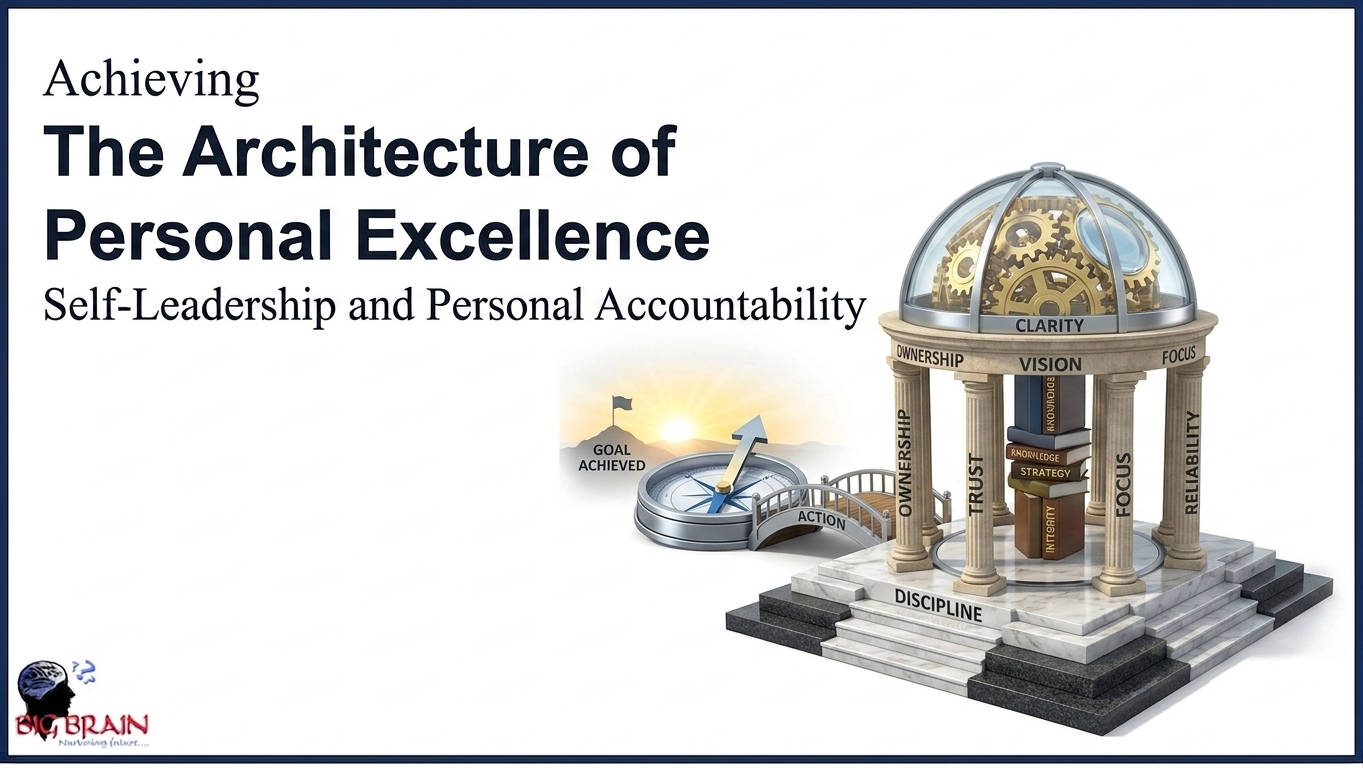
In the contemporary corporate landscape, the traditional locus of control has fundamentally shifted. Modern organizational structures are flatter, decentralized, and increasingly reliant on autonomous execution. In this high-velocity environment, the trajectory of an executive’s career depends less on structured corporate oversight and more on individual initiative. Within this framework, two interconnected behavioral disciplines emerge as the primary differentiators of organizational success: Self-Leadership and Personal Accountability.
While these concepts are frequently conflated, they represent distinct, complementary vectors of professional conduct. Self-leadership is the proactive compass—the internal strategy, cognitive alignment, and self-regulation that direct an individual’s actions. Personal accountability is the reactive anchor—the uncompromising ownership of the outcomes of those actions, whether they result in strategic triumph or operational failure. Together, they form a continuous behavioral loop that drives sustained professional excellence and organizational trust.
Part I: Foundations of Strategic Self-Leadership
Self-leadership is the practice of intentionally influencing one’s thoughts, emotional states, and behaviors to achieve targeted strategic objectives. It operates on a foundational premise: before an executive can effectively lead teams, optimize resources, or spearhead corporate initiatives, they must first master the discipline of self-guidance.
Unlike traditional leadership, which focuses on aligning and motivating a collective toward an institutional vision, self-leadership is an inward-facing capability. It requires a professional to systematically navigate their internal psychology, dismantle self-limiting cognitive frameworks, and maintain high operational momentum without requiring external supervision or continuous institutional validation.
The Core Pillars of Self-Leadership
-
Radical Self-Awareness: This entails a highly objective, data-driven assessment of one’s behavioral competencies, developmental gaps, emotional triggers, and core drivers. Self-aware leaders recognize when they are operating from a defensive or fixed mindset, allowing them to self-correct before their behavior impacts team dynamics or project delivery.
-
Self-Regulation and Executive Presence: Achieving alignment between long-term strategic objectives and daily operational tasks requires robust self-regulation. This is the capacity to manage cognitive load, emotional responses, and energy levels under high-stress conditions. It ensures that an executive chooses a calculated, value-driven strategic response over a visceral reaction when confronting workplace adversity or shifting priorities.
-
Constructive Cognitive Patterns: Manifesting professional excellence requires deliberate cognitive restructuring. This involves identifying and neutralizing counterproductive self-talk and replacing it with solution-oriented internal dialogue. Cultivating a growth mindset ensures that market disruptions and operational bottlenecks are analyzed as learning opportunities rather than systemic failures.
Part II: The Crucible of Personal Accountability
If self-leadership establishes the strategic blueprint, personal accountability provides the execution framework. Accountability is frequently misconstrued as a punitive, retrospective exercise—a mechanism invoked only when commitments are missed. True personal accountability, however, is an advanced, proactive mindset. It is the conscious willingness to accept full ownership of the outcomes of one’s decisions, behaviors, and performance metrics.
Operating “Above the Line”
Organizational behavior research demonstrates that when individuals face missed deadlines, budget overruns, or unachieved Key Performance Indicators (KPIs), their default psychological defense mechanism is often to drop “below the line.” This manifests as blame, excuses, denial, and deflection—behaviors that insulate the individual but stall organizational progress.
Conversely, operating “above the line” requires a transition into the ownership loop. When a project derails, an accountable professional bypasses external finger-pointing and critically analyzes their own execution, asking: What gaps in my oversight contributed to this outcome? What risk-mitigation strategies should I have deployed? How do we execute an immediate operational pivot?
The KSA Framework of Accountability
Accountability can be systematically institutionalized and measured by aligning three critical dimensions of performance:
-
Knowledge: This represents absolute clarity regarding expected deliverables, performance benchmarks, and organizational alignment. True accountability begins with the active elimination of ambiguity rather than operating under unverified assumptions.
-
Skills: This encompasses the technical capabilities and behavioral competencies required to execute a mandate successfully. An accountable professional actively identifies and bridges their own skill gaps rather than utilizing competency deficits as an excuse for subpar output.
-
Attitude: This is the foundational mindset that treats professional commitments as inviolable contracts. It is the internal psychological driver that prioritizes execution, discipline, and results over personal comfort or convenience.
Part III: The Symbiotic Synergy of Both Disciplines
Self-leadership and personal accountability exist in a critical, symbiotic relationship; one cannot function optimally in isolation.
When an individual possesses high self-leadership but low personal accountability, they intellectualize strategy but fail to execute. They generate innovative concepts, map out sophisticated career development plans, and possess deep emotional intelligence, yet they deflect responsibility when operational targets are missed.
Conversely, an individual with high accountability but low self-leadership becomes a highly reliable but reactive order-taker. They diligently own their tasks and work tirelessly to rectify errors, but they lack the strategic foresight to self-direct, innovate, or independently steer complex projects.
When these two disciplines are synchronized, they create an accelerating cycle of professional growth. The process initiates with the self-leader establishing a strategic objective based on objective self-awareness. They execute this objective with high self-regulation and focus. Upon conclusion, personal accountability ensures a rigorous evaluation of the results, taking ownership of both successes and performance shortfalls. The insights harvested from this review loop directly back into the executive’s self-awareness, sharpening their self-leadership capabilities for subsequent business cycles.
Part IV: Institutionalizing Leadership and Accountability
Transitioning these conceptual frameworks into ingrained professional habits requires deliberate, structured practice.
-
Execute Clear, Performance-Driven Micro-Contracts: Treat daily milestones and short-term commitments with the same gravity as a high-stakes board presentation. Consistently meeting self-imposed deadlines builds internal psychological capital and establishes a reputation for flawless execution.
-
Reframing Inquiry from “Why” to “What” and “How”: When operational processes fail, avoid defensive inquiries such as “Why did the vendor fail to deliver?” or “Why was the budget insufficient?” These questions naturally invite a victim mindset. Instead, pivot to accountable, action-oriented framing: “What immediate interventions can I deploy to salvage this timeline?” and “How can we re-engineer our vendor onboarding process to prevent this variance moving forward?”
-
Conduct Structured Performance Debriefs: At the conclusion of fiscal quarters or critical project phases, conduct a formal self-audit focused on three inquiries: identify the variance between projected commitments and actual outcomes; isolate the internal behaviors that drove successful milestones; and analyze the specific choices that contributed to execution gaps.
Conclusion: The Professional Dividend
Ultimately, mastering self-leadership and personal accountability transforms an executive’s relationship with their corporate environment. It shifts an individual from being a passive participant vulnerable to organizational restructuring, market volatility, or stakeholder pressure, into an active architect of their professional trajectory.
Within corporate teams, individuals who lead themselves and unconditionally own their outcomes generate the most valuable currency in business: trust. Trust significantly reduces organizational friction, minimizes the necessity for restrictive micromanagement, and accelerates executive advancement. By taking total command of your internal state and accepting absolute ownership of your external results, you establish a powerful model of professional excellence that elevates institutional capability.